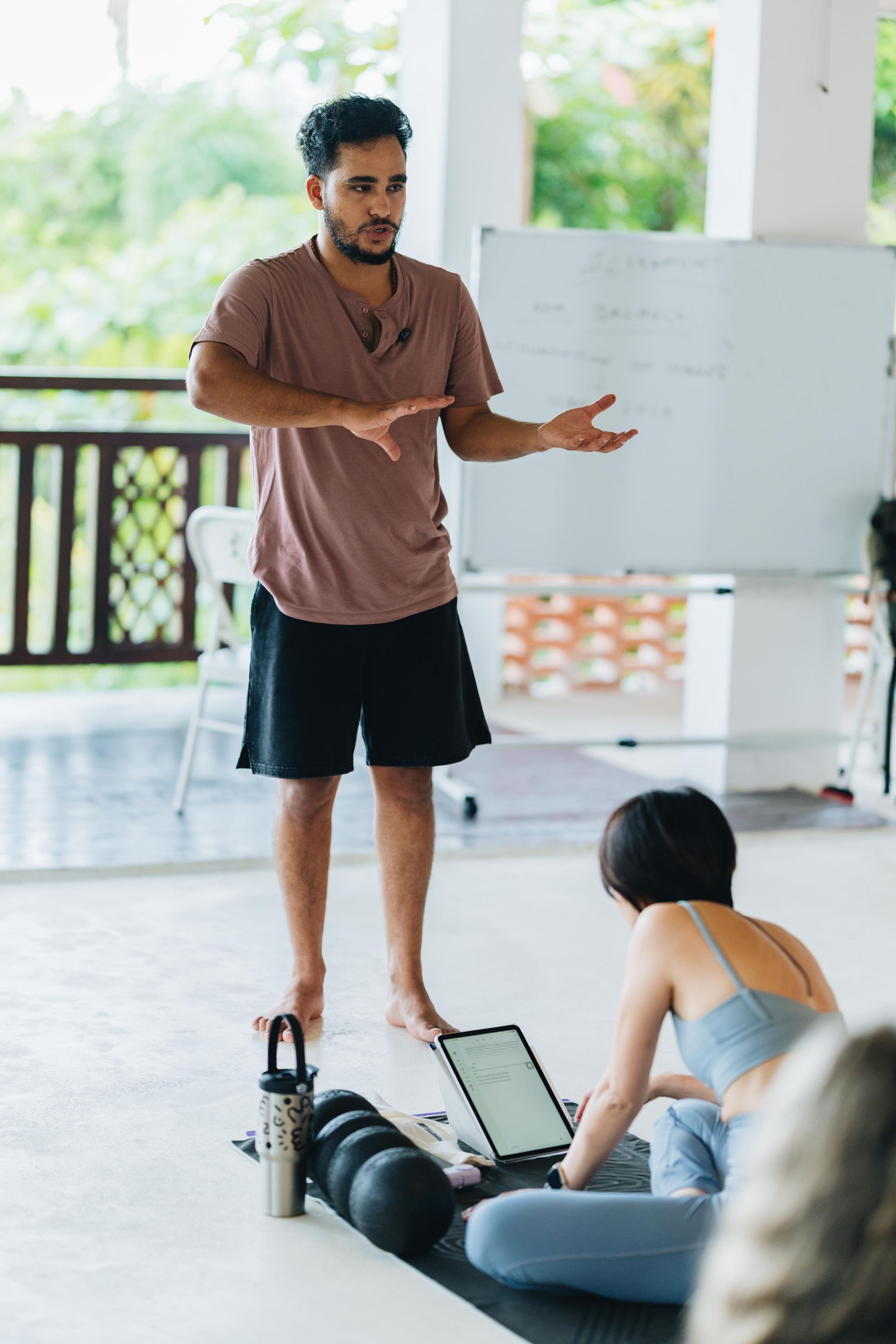
Yoga Alliance's credential system is straightforward once you see it laid out, but almost nobody sees it laid out — you piece it together from school websites that all use the terms slightly differently. So here's the actual system, as Yoga Alliance itself defines it, credential by credential.
RYT 200: The Foundation
RYT 200 is the entry-level credential, and it's what lets you register as a yoga teacher at all. You earn it by completing a 200-hour training with a school registered with Yoga Alliance at the 200-hour tier (an RYS 200). There's no teaching-experience requirement to get it — it's awarded on completion of the training itself.
The 300-Hour Training (and Why There's No “RYT 300”)
This is the part that trips almost everyone up, including plenty of schools' own marketing. Yoga Alliance doesn't actually issue an individual credential called “RYT 300.” What exists at the 300-hour level is a school registration — a school can be an RYS 300, meaning it's approved to deliver the 300-hour advanced tier of training. But when you personally complete that training, you don't walk away with a separate “RYT 300” certificate. What you walk away with is 300 hours that combine with the RYT 200 you already hold to make you eligible to apply for the next individual credential up: RYT 500.
It's a small distinction, but it's worth understanding precisely — especially if you're comparing schools and one implies its 300-hour training grants its own standalone certification tier. It doesn't; no one's does. That's simply how the system is structured.
RYT 500: The Combined Credential
RYT 500 is the highest individual teaching credential Yoga Alliance offers, and there are two paths to it: completing a single 500-hour training at an RYS 500 school, or — far more common — combining a 200-hour training with a separate 300-hour training, which don't need to be at the same school. Either route also requires logging at least 100 hours of actual teaching experience after finishing the 200-hour (or combined 500-hour) portion before you can apply.
E-RYT 200 and E-RYT 500: Experience, Not Just Hours
The “E” stands for Experienced, and these aren't credentials you can rush toward — they're proof of sustained teaching, not just training. E-RYT 200 requires your RYT 200 plus at least 1,000 hours of teaching completed over a minimum of two years. E-RYT 500 requires your RYT 500 plus at least 2,000 hours of teaching over a minimum of four years, split so that 1,500 of those hours come after your 200-hour portion and the remaining 500 come after your 300-hour portion. It's a meaningful bar, which is exactly the point — it's meant to signal real, sustained teaching experience rather than a training you completed once.
The training gets you the credential. The years of actually teaching get you the “E.”
YACEP: Not a Teacher Level at All
YACEP (Yoga Alliance Continuing Education Provider) confuses people because it sounds like it belongs in the same list as RYT and E-RYT, but it isn't a personal teaching tier at all. It's a designation a school or experienced teacher can hold that allows them to offer continuing education courses — courses whose hours count toward other registered teachers' renewal requirements. If you see “YACEP” next to a workshop or training, it means that specific offering's hours are eligible to count toward your own continuing education, not that you're earning a new credential tier.
Keeping Your Registration Current
Registration isn't a one-time achievement — Yoga Alliance requires registered teachers to log continuing education roughly every three years to keep their status active, generally split between hours spent actually teaching and hours spent in further training or workshops. It's worth checking the exact current requirement directly on Yoga Alliance's site when your renewal approaches, since these figures are occasionally updated.
If you're trying to decide whether the 300-hour step is worth taking in the first place, we wrote an honest breakdown of that too, and a realistic look at what it costs depending on where and how you train.