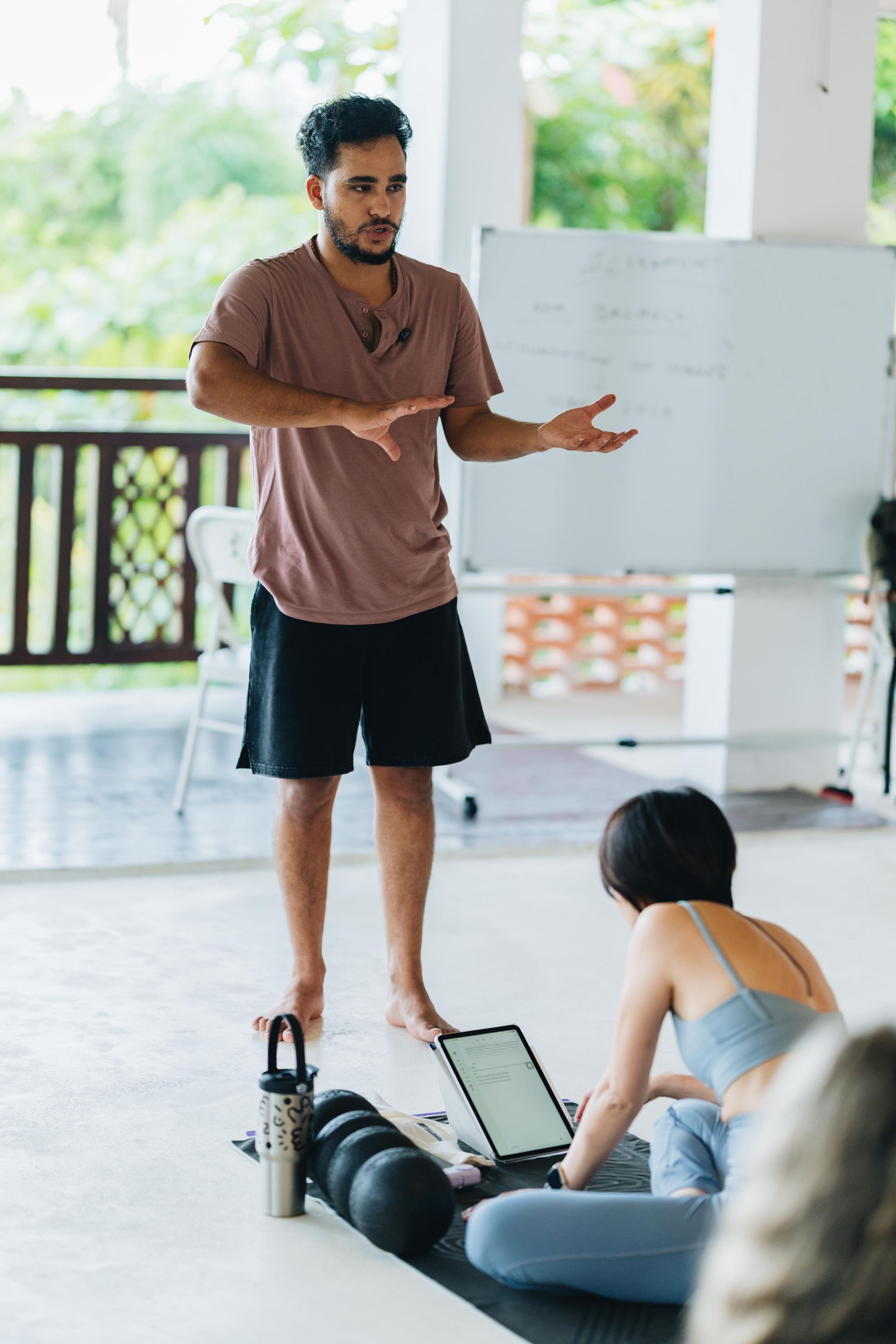
Students ask me to explain this more than almost anything else, usually after seeing a studio schedule with four different class names and no idea what actually separates them. The short version: they're not different difficulty levels of the same thing. They're genuinely different practices, with different intentions, and knowing the difference changes what you get out of each one.
Hatha — HA Refers to Sun, THA Refers to Moon
Technically, “Hatha” just means the balancing of sun and moon energy — in that sense, Vinyasa and Ashtanga are both forms of Hatha, since you're also working to balance those two energies. But in a class schedule, “Hatha” usually means something more specific: postures held for longer, less continuous flow between them, a slower and more foundational pace, with the traditional approach of practices for working on different layers of the body. It's often where people start, not because it's easier, but because it gives you time to actually feel what alignment means before you're asked to move through it quickly.
Vinyasa — Movement Linked to Breath
Vinyasa means “to place in a special way,” and in practice it refers to linking movement to breath — one breath, one movement, continuously. But that's not all — Vinyasa classes are also designed to build muscle memory through repetitive movement. Still, no two Vinyasa classes have to look the same; the sequencing is often built fresh by the teacher around a specific theme or peak pose, rather than following a fixed order. What defines it isn't the specific postures, it's that constant thread between breath and movement.
Ashtanga — The Structure Underneath Vinyasa
Ashtanga is where a lot of the confusion starts, because it's also breath-linked, flowing movement — but unlike Vinyasa, the sequence is fixed. Same postures, same order, every time, building through defined series (Primary, Secondary, and beyond). It's demanding and repetitive by design; the structure is what lets you actually track your own progress over months and years, because the only thing that changes is you.
Yin — The Opposite Pace, on Purpose
Yin is the one people most often mistake for “just stretching.” It's not. Postures are held for minutes at a time, targeting connective tissue rather than muscle — fascia, joints, ligaments — which only respond to sustained, gentle stress, not the quick engagement of a Vinyasa flow. It's a genuinely different nervous system experience too: long holds shift you toward your parasympathetic system, which is exactly why it tends to feel emotionally different from a dynamic class, not just physically different.
None of these is a “beginner” or “advanced” version of the others. They're different tools built for different outcomes.
Why We Teach All Four Together
Most teacher trainings pick one of these and go deep on it, which makes sense for a studio built around one style. But it also means most teachers graduate only able to hold one kind of room. Our 300-Hour Multistyle Training is built the opposite way — Hatha, Vinyasa, Ashtanga, and Yin, all taught with real depth rather than a surface pass through each. You don't have to pick a single teaching identity before you've even graduated.
If you already know Vinyasa or Ashtanga well and want to understand Yin specifically, we've written more on that here: Yin Yoga and the Nervous System.